
How one cinematography assignment changed the way I think about planning, production, and the cost of decisions made too late.
The Lesson I Wish I Had Learned Earlier
For years, I worked in advertising, content production, and digital marketing in Tehran. I started as a freelancer, worked as an employee, and eventually founded my own advertising agency. I managed projects, developed creative concepts, worked with production teams, and directed advertising videos for different clients.
During those years, I learned a great deal by doing. I built a team, developed our own working methods, and gradually figured out how to take projects from an initial idea to a finished product.
But there was one part of the production process that I had never fully understood or implemented as systematically as I should have: pre-production.
We would discuss the concept, develop the script, explain the general requirements to the team, and move toward the shoot. Sometimes, I would share specific instructions or reference materials, but there was no consistent, comprehensive document that brought every important production detail together.
Our team was relatively small, and several people had learned their jobs primarily through practical experience. They knew how to perform their tasks, but formal pre-production planning was not necessarily part of their working process. I had developed my own way of managing projects, and the team had developed its own habits. We had a system, but it was a system we had largely built ourselves rather than one based on a structured production methodology.
As a result, I often had to be physically present during filming to make sure things happened as intended.
If I was not there, something could go wrong. A detail might be overlooked, a shot might be interpreted differently from what I had imagined, or a decision might be made on set without considering its consequences for the rest of the project.
At the time, I saw this as part of managing a small production team. I believed that staying involved, answering questions, and solving problems as they appeared was simply how the work had to be done.
Then, during my third semester at St. Joseph’s University in Bengaluru, I took a cinematography class with Professor M. S. Dulip Kumar. One of our assignments was to prepare a detailed pre-production file before creating our final advertising films.
The assignment made me reconsider years of professional experience.
For the first time, I was not simply being asked to make a film or produce an advertisement. I was being asked to document the decisions that would make the production possible.
And I began to understand how many problems could be prevented before a camera was even switched on.
What Is Pre-Production, and Why Does It Matter?
Pre-production is the planning stage that takes place before filming begins. It is where the creative idea is developed into a practical plan that the production team can understand and execute.
It includes much more than writing a script.
Depending on the project, pre-production may involve the creative concept, script, client brief, target audience, visual references, storyboards, shot lists, camera and lens choices, lighting plans, production design, props, wardrobe, locations, schedules, budgets, crew responsibilities, and technical requirements.
The purpose is not to predict every possible problem or eliminate the need for creative decisions on set. Film production will always involve unexpected situations.
The purpose is to make the important decisions visible before they become expensive problems.
A good pre-production file answers several fundamental questions:
- What are we making, and why?
- What should the audience understand or feel?
- What will the film look and sound like?
- How will we capture each important moment?
- What equipment, people, locations, and resources do we need?
- What must remain consistent throughout production?
- How much time and money will the project require?
When these questions are answered in advance, the team has a shared reference point. Instead of relying entirely on verbal instructions or individual interpretations, everyone can work toward the same goal.
This is particularly important when the director cannot personally supervise every department at every moment.
The Cost of an Unplanned Decision
One experience from my advertising work explains why this matters better than any definition could.
We were filming an advertisement built around a moment in the main character’s everyday life. The concept depended on the feeling that the action was taking place within a single continuous moment. The character’s appearance, including her clothing, was therefore an important part of the visual continuity.
Before filming, I explained the project to the team and gave them the necessary instructions. Then, for a short period, I had to leave the set to take care of a banking matter. I expected to return in less than an hour and assumed that production would continue according to the plan we had discussed.
When I returned, I found the main actress wearing a different outfit. The cinematographer was filming her in it.
I was confused. Why had her clothes changed?
The explanation was surprisingly simple: the actress had suggested that another outfit looked better on her. The cinematographer had agreed after seeing it, and they had decided to continue filming with the new clothing.
From their perspective, it may have seemed like a harmless creative improvement. The new outfit looked good, and the decision had been made with the intention of improving the image.
But nobody had considered what that decision meant for the story.
The advertisement was supposed to portray a single moment. The character could not suddenly appear in a different outfit without a narrative reason. The visual change would make the audience aware of a discontinuity that was never meant to exist.
I immediately asked how much footage had been recorded. Fortunately, they told me that they had not filmed very much in the new outfit.
The real extent of the problem became clear later, during post-production.
We now had footage of the same character, in the same supposed moment, wearing two different outfits. Reshooting would have required additional coordination, time, and money. It was also becoming difficult to arrange another shoot.
Eventually, I changed part of the storyline and restructured the edit to make the difference in clothing less noticeable. Since the outfits had a similar design but different colours, I tried to arrange the footage so that the visual discontinuity would be less apparent.
We found a solution, but it was a compromise. I had to change the story to accommodate a problem that should never have occurred in the first place.
Looking back, I do not think the lesson is that nobody should ever make a creative suggestion on set. Filmmaking depends on collaboration, and unexpected ideas can improve a project.
The problem was that a decision affecting the continuity of the film was made without considering the wider production plan.
A simple wardrobe note, a continuity reference, or a clear rule about who could approve changes would have helped prevent the situation.
That experience taught me something I understood much more clearly after my university assignment: a production problem is not always caused by a lack of talent or effort. Sometimes, it is caused by a lack of shared information.
My University Assignment: Four Advertising Films, Four Production Plans
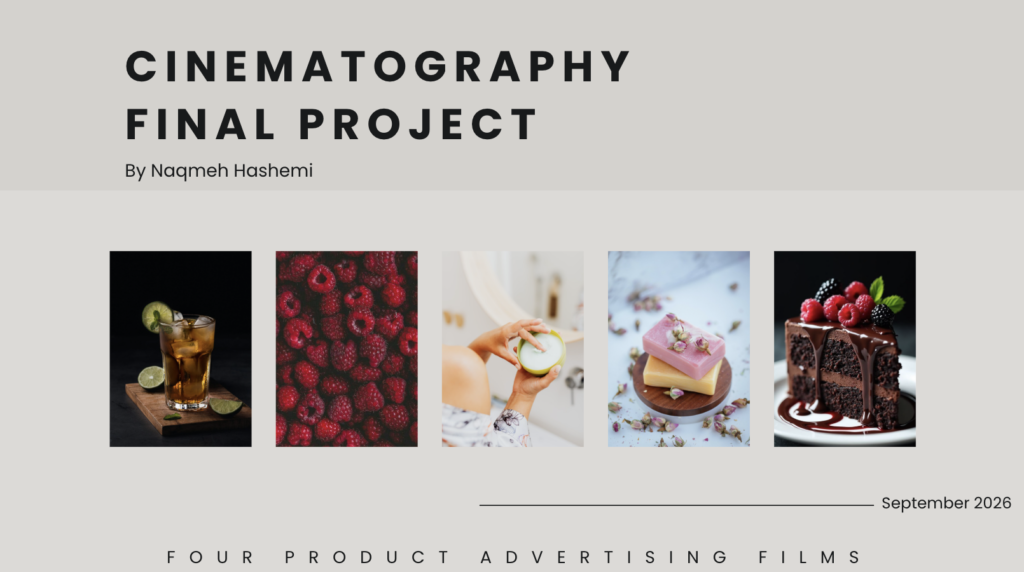
For our cinematography final project in September 2026, we were asked to develop four product advertising films, each with its own creative concept and visual language.
The products were:
- A chocolate and raspberry cake.
- A body lotion.
- A soap.
- A beverage.
Each film needed a distinct visual identity. The cake commercial focused on richness, texture, and indulgence. The body lotion film explored softness and self-care. The soap commercial emphasized natural ingredients, water, and tactile details. The beverage film aimed to communicate freshness, energy, and the feeling of enjoying the present moment.
Although all four films were product advertisements, they could not be approached in exactly the same way. Each required different visual choices, lighting decisions, camera movements, and production details.
For every product, I developed a pre-production document covering the creative direction and the practical requirements of the shoot.
The process included defining the client brief, communication objective, creative idea, storyline, target audience, and core message. I then developed the visual direction, synopsis, storyboards, shot division, camera approach, lighting design, equipment list, production design, schedule, budget, and location requirements.
My initial documents became very detailed, reaching approximately twenty pages per product. Across four films, that meant around eighty pages of planning material.
I found the process fascinating. At the same time, I began asking myself a practical question: if I were sending a real production team to shoot these advertisements, would everyone realistically read twenty pages of documentation for each product?
Probably not.
A document can contain valuable information and still fail if the people who need it cannot use it efficiently. Production teams work under time pressure. They need the right information at the right moment, not necessarily every piece of information in one enormous document.
That realization became another important lesson. Pre-production needs to be comprehensive in its thinking, but practical in its presentation.
The aim is not to produce the longest file. It is to create a reliable plan that the team can understand, consult, and follow.
How to Build a Useful Pre-Production File
There is no single format that works for every film. A feature film, documentary, music video, and thirty-second product advertisement have different requirements.
However, the following structure is a useful starting point for a short film or advertising production. You can expand or simplify it depending on the project’s scale, budget, and complexity.
1. Project Overview
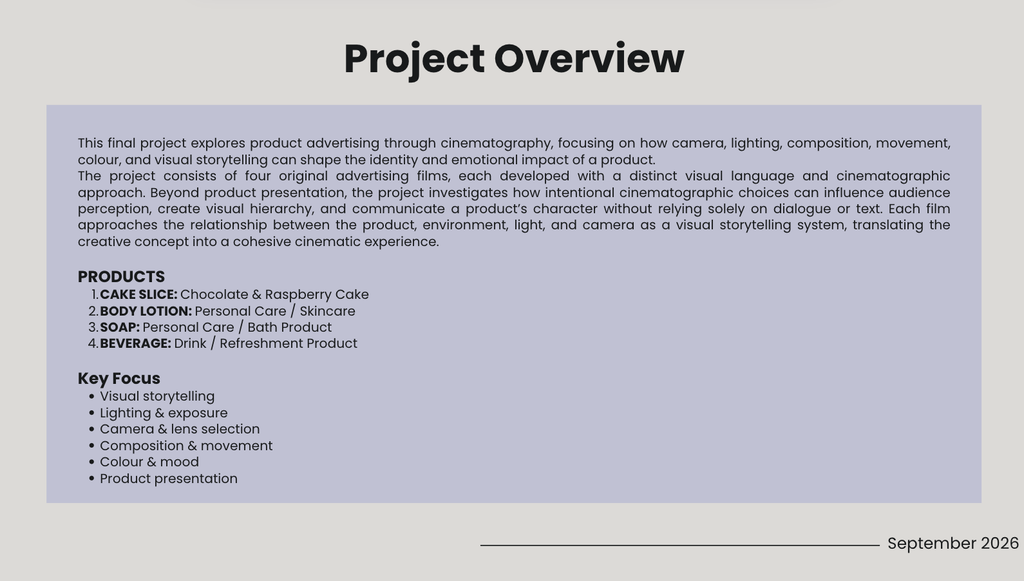
Start by explaining what the project is.
Include the project title, type of production, client or intended audience, date, director, and a short description of the project.
For a commercial, identify the product or service being advertised. For a short film, introduce the premise and the general creative direction.
Why it matters: The overview gives everyone a common understanding of the project before they look at individual technical details.
For my final project, I began with an overview explaining that the four films would explore how camera, lighting, composition, movement, colour, and visual storytelling could shape the identity and emotional impact of a product.
That statement established the larger purpose behind the individual films.
2. Client Brief and Communication Objective
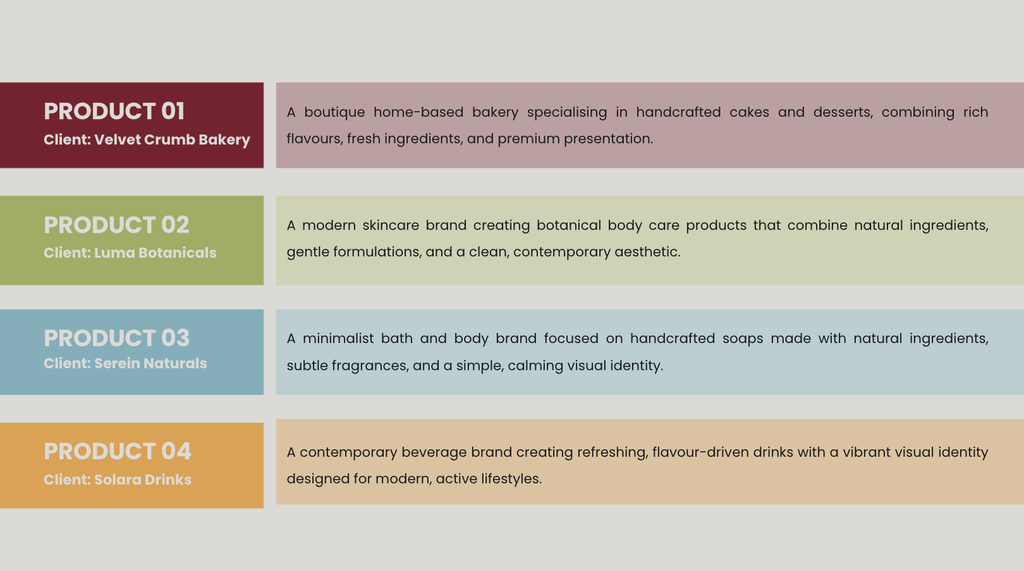
The client brief explains what the client wants to communicate and what the production is expected to achieve.
For an advertising film, this may include:
- The product’s key qualities and benefits.
- The target audience.
- The desired audience response.
- The central message.
- The intended platform or format.
- Any mandatory information, branding, or visual requirements.
It is useful to distinguish the communication objective from the creative idea.
The communication objective describes what the film should achieve. The creative idea describes how the film will achieve it.
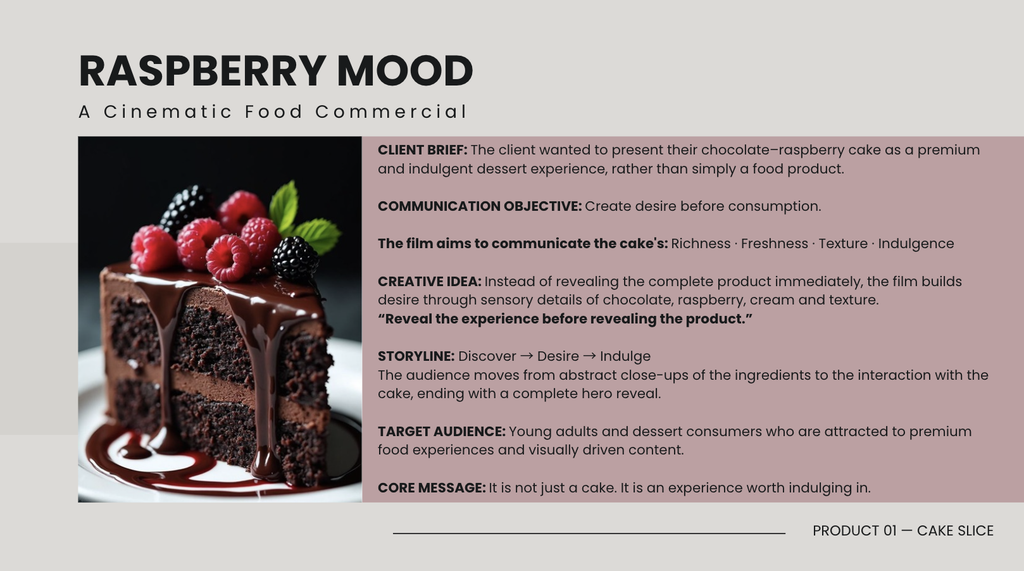
For example, the objective for my cake advertisement was to create desire before consumption. The creative idea was to reveal the sensory experience of chocolate, raspberry, cream, and texture before showing the complete cake.
Why it matters: Without a clear objective, a production can become visually attractive without communicating the intended message.
3. Creative Concept and Storyline
Once the objective is clear, define the central creative idea.
Explain the approach, the emotional experience you want to create, and the sequence through which the audience will experience the film.
For my cake advertisement, the storyline was:
Discover → Desire → Indulge
The film would move from abstract ingredient details to the interaction with the cake, ending with a complete product reveal.
For the body lotion, the sequence was:
Discover → Touch → Soothe
The storyline moved from intimate product and texture details toward the experience of applying the lotion.
These short structures made the intention of each film easy to understand.
Why it matters: A clear storyline gives the director, cinematographer, editor, and other collaborators a common understanding of how the film should develop.
4. Visual References and Visual Direction
Words such as cinematic, premium, natural, and energetic can mean very different things to different people.
Visual references help turn abstract descriptions into something more concrete.
This section can include reference images, lighting examples, colour palettes, composition ideas, camera movement references, and examples of the desired atmosphere.
For each reference, explain what you want to take from it. Is it the lighting, the composition, the colour relationships, the movement, the texture, or the emotional effect?
The goal is not to copy another film. It is to communicate a visual intention.
Why it matters: Visual references reduce ambiguity and make creative conversations more precise.
5. Synopsis and Storyboards
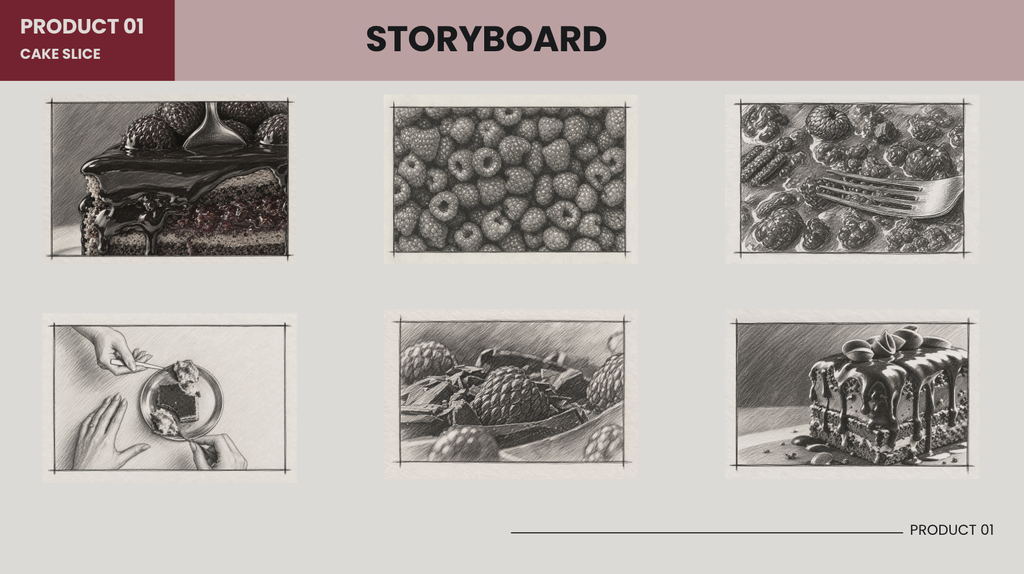
A synopsis provides a concise description of the film’s visual progression. A storyboard translates that progression into a sequence of frames.
Storyboards do not need to be elaborate illustrations. Clear sketches, reference images, or simple diagrams can be enough, provided they communicate the intended action and composition.
For each frame, consider showing:
- What appears in the image.
- Where the subject and important objects are positioned.
- What the audience should notice.
- How the frame connects to the previous and next shots.
For my product films, the storyboards helped me visualize the progression from detail shots to the final hero shot.
Why it matters: A storyboard allows the team to discuss and revise visual ideas before spending time setting up the camera and lighting.
6. Shot List and Shot Division
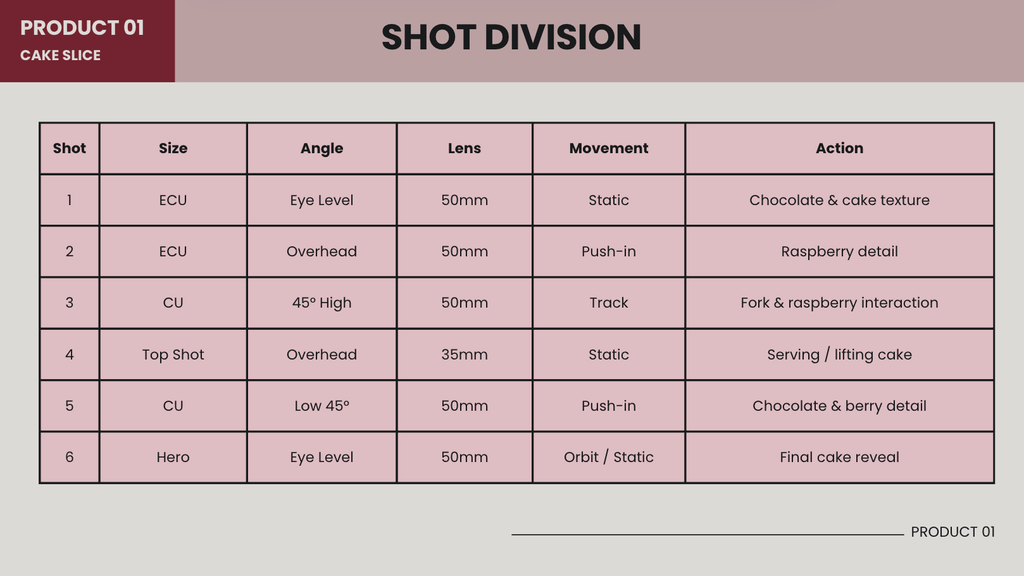
The storyboard communicates the visual idea. The shot list translates it into a practical shooting plan.
A useful shot list can include:
| Field | What it specifies |
|---|---|
| Shot number | A unique reference for each shot |
| Shot size | ECU, CU, medium shot, wide shot, or another framing |
| Camera angle | Eye level, high angle, overhead, low angle, and so on |
| Lens or focal length | The intended lens or focal length |
| Camera movement | Static, pan, tilt, tracking, push-in, orbit, etc. |
| Action | What happens in the shot |
| Lighting notes | Special lighting requirements |
| Continuity notes | Wardrobe, props, product position, and other details |
For example, one of my cake shots was an extreme close-up of the cake’s texture, followed by an overhead shot of the cake being served. Each shot had a defined purpose within the overall visual progression.
The exact focal length or camera movement can remain flexible when the cinematographer needs room to make informed decisions on set. What matters is that the intended result is clear.
Why it matters: A shot list helps estimate the time required for production, organize setups, track completed shots, and reduce the risk of forgetting essential footage.
7. Camera, Lens, and Technical Approach
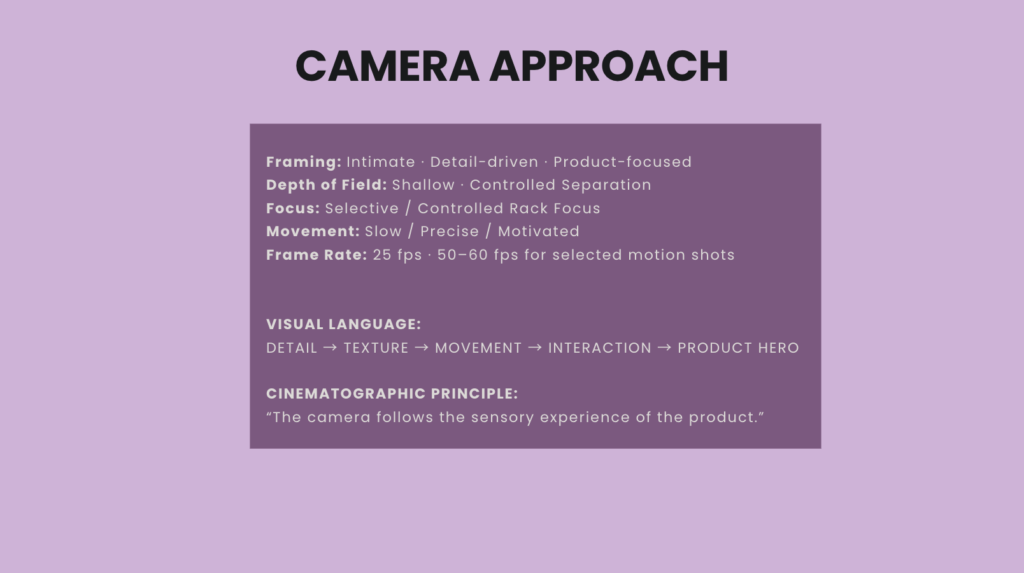
This section documents the technical approach to capturing the images.
Depending on the project, it may include:
- Camera body and recording format.
- Resolution and bit depth.
- Frame rate and shutter settings.
- Intended ISO range or exposure considerations.
- Picture profile and colour workflow.
- Lens selection and focal lengths.
- Depth-of-field preferences.
- Camera support and movement equipment.
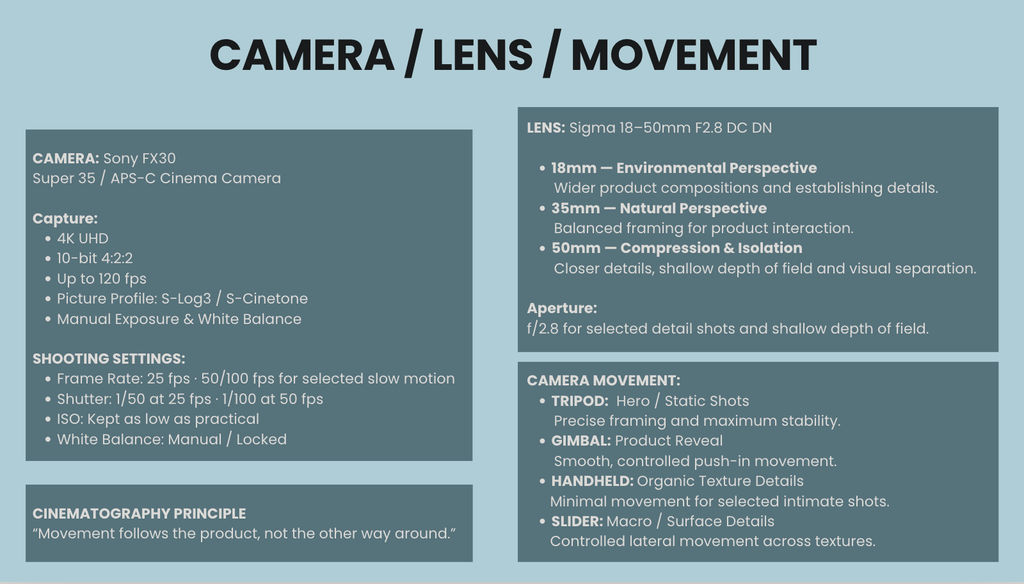
For my project, I planned to use a Sony FX30 with a Sigma 18–50mm F2.8 lens. I also documented the intended use of a tripod, gimbal, and other camera support depending on the shot.
The important point is that these settings should serve the creative intention. A technical choice should not be included simply because it sounds professional.
For instance, slow motion may emphasize a liquid pour or a falling ingredient, while a static frame may give a product a more controlled and deliberate presentation.
Why it matters: Documenting the technical approach helps the team prepare the correct equipment and understand why particular choices have been made.
8. Lighting Design
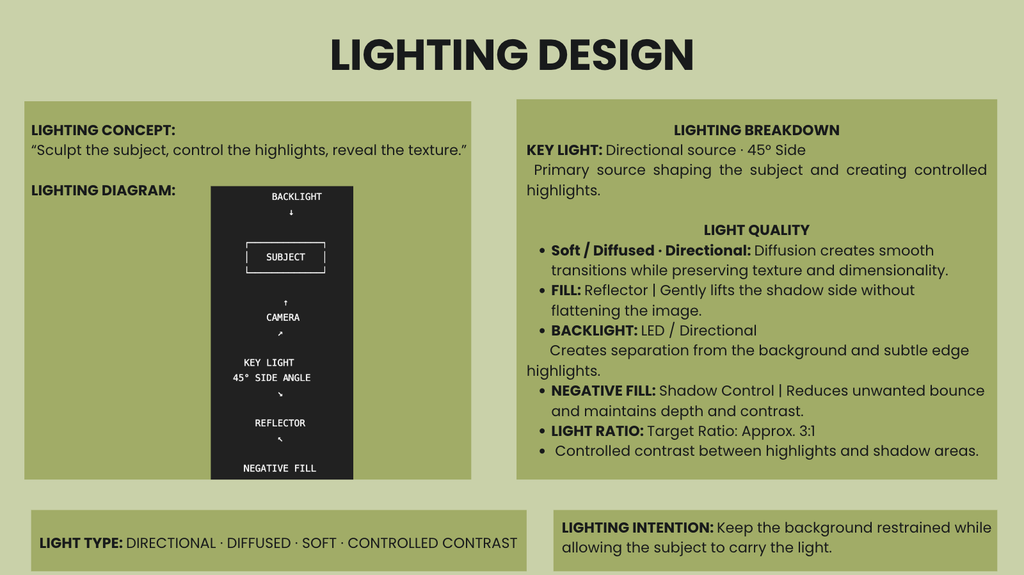
Lighting is one of the most important parts of cinematography, and it deserves its own section.
Document the intended key light, fill, backlight, diffusion, reflectors, negative fill, practical lights, and other relevant sources or modifiers.
You can also include a lighting diagram showing the position of the subject, camera, and light sources.
For a product film, explain how the light should reveal the product’s characteristics. A cake may require controlled highlights to show texture and richness. A lotion may benefit from soft light that communicates gentleness. A beverage may need backlighting to emphasize liquid, ice, and condensation.
Why it matters: Lighting notes help the cinematographer and lighting team prepare the necessary equipment and reproduce the intended visual approach more consistently.
9. Colour Palette, White Balance, and Exposure
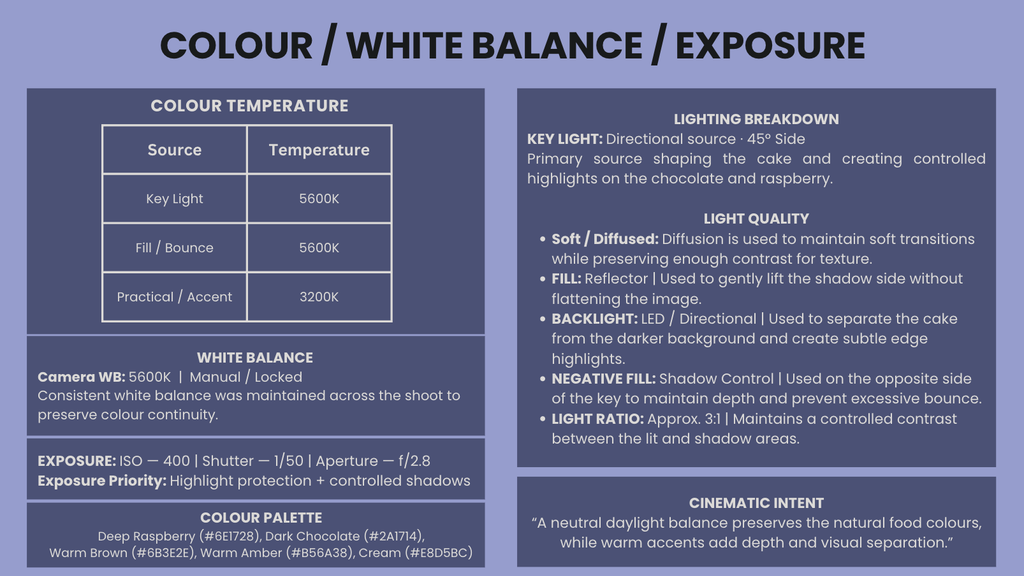
This section connects the desired look with practical image-making decisions.
Include the intended colour palette, white-balance approach, exposure priorities, and any important considerations for colour continuity.
For example, my cake advertisement used a palette built around deep raspberry, dark chocolate, warm brown, amber, and cream. Those colours supported the rich and indulgent mood of the concept.
White balance and exposure notes help the team avoid unnecessary inconsistencies between shots. The exact settings should still be adjusted to the actual lighting conditions and camera requirements.
Why it matters: Colour and exposure are not merely technical details. They influence mood, product appearance, visual continuity, and how the audience perceives the image.
10. Equipment, Props, Wardrobe, and Production Design
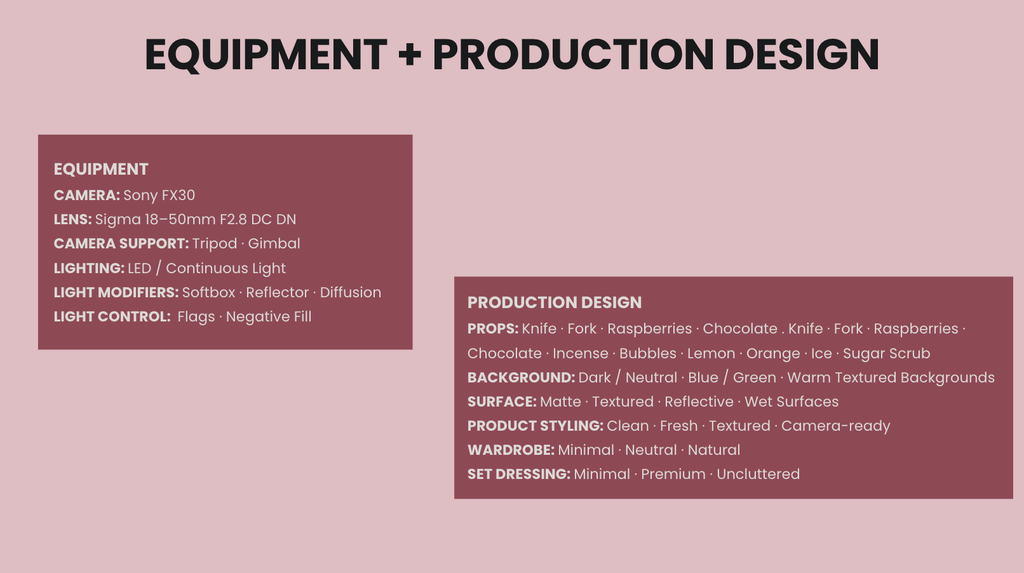
List what the production needs before filming begins.
This may include cameras, lenses, tripods, gimbals, lights, modifiers, cables, batteries, memory cards, props, product samples, wardrobe, set materials, and any other items required for the shoot.
For product advertising, styling is especially important. A product may need to be cleaned, arranged, replaced between takes, or prepared in multiple versions.
Wardrobe and props also need continuity notes when the story takes place over a short period or when multiple shots will be edited together.
Why it matters: A checklist prevents avoidable delays caused by missing equipment, forgotten props, unsuitable wardrobe, or products that are not ready for filming.
11. Location and Production Schedule
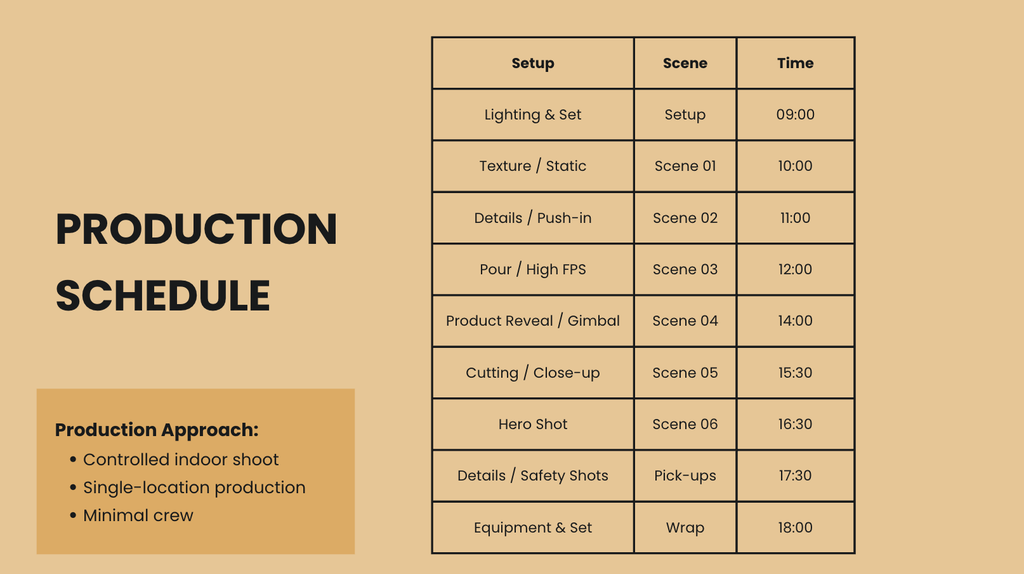
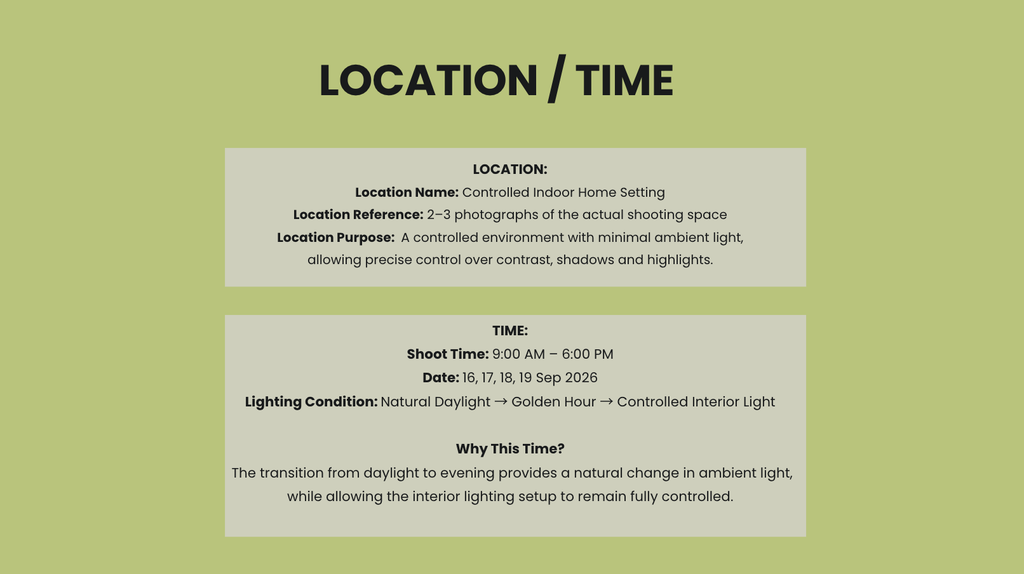
Document the location, relevant photographs, available space, environmental conditions, access requirements, and any practical limitations.
Then create a schedule that identifies the planned shooting order and estimated time for each setup.
A schedule might include time for lighting and set preparation, product styling, camera tests, individual scenes, pickups, and equipment wrap.
The shooting order does not always need to follow the final edit. Grouping shots by location, lighting setup, or equipment configuration can make production more efficient.
Why it matters: A realistic schedule helps the team coordinate its work and reduces the risk of running out of time before essential shots are completed.
12. Budget and Crew Responsibilities
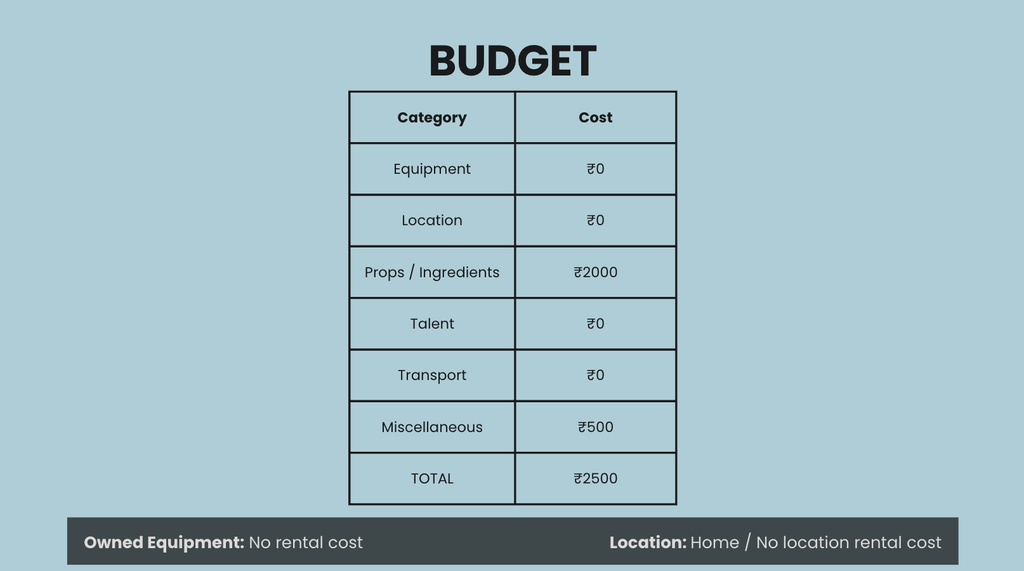
The budget should identify the anticipated costs of equipment rental, location fees, props, ingredients, talent, transport, meals, and other production expenses.
If equipment is owned or a location is free, record that too. A zero-cost line item is still useful information because it clarifies the resources available and prevents assumptions about what needs to be rented.
The file should also identify who is responsible for key tasks and who has the authority to approve changes.
This does not need to become a complicated organizational chart. Even a small production benefits from clear responsibilities.
Why it matters: Budget planning supports informed decisions about resources, while clearly defined responsibilities reduce confusion during production.
13. Continuity Notes and Final Checks
Before filming, identify the details that must remain consistent across shots.
These may include wardrobe, hair and makeup, props, product placement, liquid levels, ingredient arrangements, lighting direction, camera position, and actor movement.
For more complex productions, photographs of the set, wardrobe, props, and product arrangement can serve as continuity references.
A final checklist should confirm that the script, shot list, equipment, props, location, schedule, and crew responsibilities are ready.
Why it matters: Continuity notes help preserve the logic of the story across separate takes and setups. They also reduce the chance that a small on-set decision will create a large problem in post-production.
The Most Important Part: Make the File Usable
After producing four detailed pre-production documents, I realized that a complete file and a practical working document are not necessarily the same thing.
The research and planning behind a production may be extensive, but the crew needs information in a format that can be understood quickly and consulted while working.
For that reason, I would approach a real production with two connected layers of documentation.
The first is a concise production overview. It contains the essential creative direction, schedule, key contacts, major requirements, and links or references to the detailed material.
The second is the detailed production file. It contains the full brief, storyboards, shot list, camera and lighting plans, equipment list, continuity references, budget, and other information relevant to the production.
The overview helps the team understand the project quickly. The detailed file provides the information needed when questions arise.
This structure also makes it easier to tailor the document to different team members. The cinematographer may need the camera and lighting plans immediately, while the production coordinator may focus on the schedule, location, equipment, and responsibilities.
The aim is not to make everyone read every page. It is to make sure everyone can access the information they need.
A well-organized file can be detailed without becoming impractical.
Pre-Production Is Also a Reference for the Future
One benefit of documentation became particularly clear to me while working on these assignments.
A production file does not lose its value when filming ends.
It becomes a record of the creative and technical decisions behind the finished work. If you revisit the project months or years later, you can examine the original concept, camera settings, lighting approach, equipment, shot design, and production schedule.
You can compare what you planned with what actually happened. You can identify which decisions worked, which created difficulties, and what you would change next time.
This is especially valuable for filmmakers developing their own working methods. Instead of relying entirely on memory, you can build a personal archive of production experience.
For an advertising agency, such records can also help with future campaigns, repeat clients, team onboarding, and the development of more consistent workflows.
The file becomes more than a document created to satisfy an assignment. It becomes a source of knowledge that can inform the next project.
What I Would Change About My Earlier Productions
When I look back at my years in advertising, I sometimes wonder how much time and money we could have saved if we had used a more structured pre-production process.
Perhaps I would not have needed to supervise every shot so closely. Perhaps the team would have understood the creative requirements more clearly. Perhaps we could have avoided some of the problems that forced us to find solutions during post-production.
I cannot know how every past project would have turned out under a different system. Some problems are unavoidable, and planning cannot replace experience, communication, or creative judgment.
But I now recognize that many of the decisions I used to make verbally could have been documented. Many of the questions that repeatedly interrupted production could have been answered before filming. And some of the responsibilities I carried personally could have been shared more effectively with a team that had a clear plan.
This is one reason I have found returning to education so valuable.
My professional experience gave me real situations to think about. The academic process gave me a more structured way to understand them. When I worked on the pre-production assignment, I could connect every section of the file to a problem or decision I had encountered in practice.
I was not simply learning a new production document. I was reconsidering the way I had worked for years.
I also realized that learning through experience and learning through formal education do not have to compete with one another. Practical experience helps you understand why a method matters. Structured learning can help you recognize the principles behind it and apply them more consistently.
For me, the most valuable learning often happens when those two approaches meet.
Before You Start Filming, Start Thinking
I thanked Professor M. S. Dulip Kumar several times for this class and assignment because it taught me something I wish I had understood much earlier in my professional life.
A filmmaking assignment does not have to be valuable only because it results in a finished film. Sometimes, the process of preparing to make that film teaches you just as much.
Pre-production forces you to think through your intentions, communicate them clearly, anticipate practical requirements, and consider how individual decisions will affect the whole project.
It does not remove creativity from the set. It gives creativity a stronger foundation.
You can still change a shot, discover an unexpected idea, or adapt to a location that looks different from your references. The difference is that you will understand what the change means, which other decisions it affects, and whether the benefit is worth the cost.
That is the kind of filmmaking process I want to continue developing: one in which creative decisions are supported by preparation, technical understanding, and thoughtful collaboration.
If I could give one piece of advice to someone starting out in filmmaking or advertising, it would be this:
Do not wait until a problem appears on set to begin thinking about how your production should work. Start documenting the important decisions before you arrive.
Your pre-production file does not need to be eighty pages long. It needs to be clear, complete enough for the project, and useful to the people who will bring it to life.
The more carefully you prepare, the more attention you can give to what matters when the camera starts rolling: making the film.