
How studying the technical side of filmmaking changed the way I look back on years of advertising work, creative decisions, and the people behind the image.
When Experience Is Not the Same as Understanding
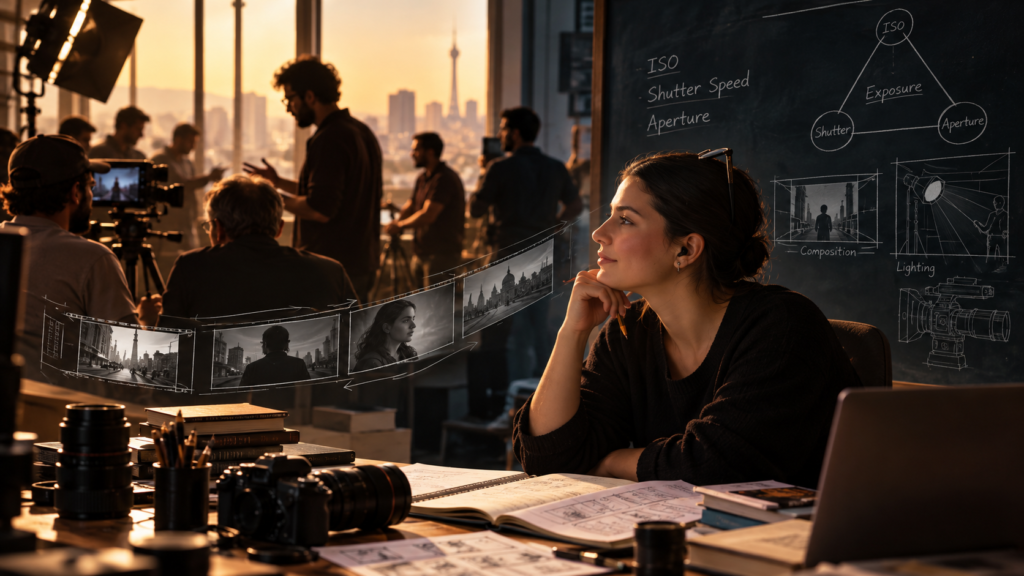
This semester, I had a cinematography class with Professor M.S.Dulip Kumar at St. Joseph’s University in Bengaluru. It became one of the most valuable and satisfying learning experiences I have had since returning to education.
What made the class particularly meaningful was not simply learning about cameras, lenses, lighting, or exposure. It was discovering how much a deeper understanding of the technical side of filmmaking can change the way we approach creative work.
For years, I had worked in advertising in Tehran. I started as a freelancer, later worked as an employee, and eventually founded my own advertising agency. Over that time, I worked on different projects, managed creative teams, coordinated productions, and made decisions about budgets, equipment, and the people we brought onto each project.
How I Learned to Take Creative Ownership
My journey into filmmaking did not begin with technical knowledge or even with a clearly defined role as a writer and director. It evolved gradually, alongside my experience in the advertising industry.
When I founded Websun Agency in Tehran, I was often the youngest person on the team, despite being the project manager and eventually the CEO. I wanted the company to grow and the quality of our work to improve, so I made a conscious effort to bring in people who had more professional experience than I did. I believed that working with people who knew more than me was one of the best ways to build a stronger team.
In the beginning, this also shaped the way I approached creative projects. I would explain the general idea or objective, then trust the people responsible for each part of the production to figure out the best way to execute it. I might give an editor a general direction and ask them to explore the edit, or brief a photographer or videographer on the project and leave much of the creative execution to their judgment.
I was comfortable delegating because I respected their experience and believed they had the knowledge to make the right decisions. At that stage, I did not always feel the need to write a detailed script or define every creative choice myself. I was focused on managing the project, coordinating the team, and making sure we delivered good work.
Gradually, however, I became more confident in my own creative judgment. I started taking a more active role in developing concepts, writing scripts, and shaping the visual direction of our projects. Instead of simply communicating an idea and leaving the execution to others, I began to develop a clearer vision of what I wanted to achieve and direct the team toward it.
That transition was important. I was learning to take greater creative ownership of the work, not just responsibility for managing its production.
But taking ownership of a creative vision did not automatically mean understanding every technical decision required to realize it.
My background was rooted in writing, directing, and project management. I worked closely with cinematographers, photographers, lighting professionals, and editors, but I had not worked professionally in those specialized technical roles myself. I understood the general language of production and had some familiarity with basic photographic concepts, including ISO, shutter speed, and aperture, but I had not studied cinematography in depth.
In the early days, I was genuinely happy with all of the projects we completed. Simply making something and seeing it come to life was exciting enough. I still remember one of the first videos we produced for a client. For weeks, I watched it at least ten or fifteen times a day. I was not thinking about where the project might lead or how much further we could go. I was simply thrilled that we had made something real, something that brought me a little closer to the path I had always wanted to pursue. At that stage, having a finished video of our own felt like an achievement in itself.
Gradually, however, my expectations began to change. As we completed more projects, I became better at recognizing what worked and what did not, what could be improved, and which aspects of a production deserved more time and attention. My eye became more critical, and my understanding of quality grew alongside my experience. I began to notice details I might not have questioned before, and I developed a clearer sense of what I wanted our work to achieve.
But recognizing that something could be better was not the same as knowing exactly how to make it better.
I knew how to communicate what I wanted a project to achieve. What I did not always know was how to evaluate the technical explanations I received when the result fell short of my expectations, or how to identify alternative ways of achieving the same creative intention.
The Camera Was Always the Problem
In the early years of my agency, we worked with a Canon 70D. As a small business, we had to be careful with our resources. We tried to keep our team relatively small while maintaining a high level of productivity, and investing in expensive camera equipment was not always practical.
Whenever I assigned a photographer or videographer to a project, I sometimes encountered resistance to using that camera.
If the focus was not accurate, I might hear that the problem was the camera itself. If the footage did not look as good as expected, the explanation might be that Canon was not the right choice and that we should have been using Sony instead.
At the time, I accepted many of these explanations. I knew enough to understand that cameras had different capabilities, but I did not have the technical knowledge to evaluate every claim independently.
Eventually, I decided to spend more money on production equipment. Since buying new cameras and lenses was not financially practical, I began renting equipment for projects. We rented Sony cameras and, when required, other camera models and lenses requested by the production team.
I expected this investment to resolve some of the problems we had been experiencing.
Sometimes, it helped. But the explanations did not always end there.
When an image looked noisy, the lighting conditions became part of the discussion. When the available light was insufficient, the limitations of the location were raised. If we considered turning off the existing lights and relying on tungsten lighting instead, we still had to deal with the consequences for exposure and the overall look of the image.
There were genuine technical constraints in some of these situations. Different cameras have different capabilities, and lighting conditions can significantly affect image quality. Equipment does matter.
But looking back, I realize that I did not always have the knowledge to distinguish between a genuine technical limitation and a problem that might have been addressed through a different technical or creative decision.
I was responsible for the project, the budget, and the final result. Yet, in some situations, I had to rely almost entirely on someone else’s interpretation of why something had gone wrong.
That was not necessarily a failure on anyone’s part. It was also a limitation in my own understanding.
What I Could Not See at the Time
The Canon 70D was not going to perform identically to every other camera in every situation. No amount of technical knowledge changes the physical capabilities of a piece of equipment. There are real differences in autofocus performance, low-light capabilities, dynamic range, lens options, and many other factors.
The mistake would be to assume that a camera is irrelevant. It is not.
The mistake is to treat the camera as the automatic explanation for every disappointing result.
A camera may limit what is possible, but it does not independently determine the quality of an image. The decisions made by the person operating it matter just as much: how the shot is exposed, where the camera is positioned, how the frame is composed, how focus is managed, how the available light is used, and whether the chosen equipment is appropriate for the task.
These are different problems, and they require different solutions.
A more expensive camera cannot automatically correct a poorly considered composition. A new lens cannot replace an understanding of how focal length affects perspective and framing. Better equipment may provide more flexibility, but someone still has to know how to use that flexibility.
I had understood these ideas in a general sense. What I lacked was the deeper technical knowledge to examine them in practice, ask more precise questions, and participate in decisions with greater confidence.
My cinematography class began to change that.
As I studied the subject more carefully, I found myself revisiting situations from my professional past. I started thinking about projects that had cost more than expected, images that had disappointed me, and decisions I had made without fully understanding the alternatives.
I could not know, years later, exactly what had caused every problem. But I could finally recognize the questions I had not known to ask.
Why a Director Needs to Understand Cinematography
I do not believe a film director needs to know everything a Director of Photography knows.
A cinematographer’s expertise involves years of specialized knowledge, practical experience, and artistic judgment. The director and the cinematographer bring different strengths to a collaboration, and a good production depends on their ability to work together.
The director does not need to take over the cinematographer’s job. The director needs enough understanding to communicate an intention, discuss the available options, and make informed decisions.
Imagine a director who wants a particular composition. The Director of Photography explains that it will not work because of a technical limitation.
There are several possibilities.
Perhaps the proposed shot really is impractical with the available equipment, location, lighting, or production time. Perhaps there is a technical solution that the director has not considered. Perhaps the shot is possible, but it requires a compromise elsewhere. Or perhaps the cinematographer has a different artistic interpretation of the scene.
Without a basic understanding of cinematography, the director may have difficulty distinguishing between these possibilities.
With that understanding, the conversation can become more productive. Instead of simply accepting or rejecting the explanation, the director can ask why the shot is not possible, what alternatives exist, and which elements of the original intention can be preserved.
Sometimes, the answer will be to change the shot. Sometimes, it will be to change the equipment, lighting setup, or camera position. Sometimes, the cinematographer will offer a better solution than the one the director initially imagined.
And sometimes, the discussion may reveal that the two people have fundamentally different approaches to the scene.
That does not automatically mean someone is wrong. But the director needs to understand enough to make a considered decision, including whether the collaboration is the right fit for the project.
Technical knowledge does not eliminate disagreement. It gives both people a more useful language in which to have it.
For me, that is one of the most important reasons filmmakers should study the technical foundations of their craft.
The Same Lesson Applies Beyond the Camera
The more I learn about filmmaking, the more I recognize that this principle extends far beyond cinematography.
During my years in advertising and content creating, I encountered situations in which technical problems emerged during production or became apparent only in post-production.
Audio is one example that comes to mind.
On some interview projects, we used two microphones, but one of them did not produce the expected sound quality. In post-production, I was sometimes told that the recording could not be properly repaired. The team might try to improve it, but the final recommendation could be to film the interview again.
Reshooting meant more than recording a new audio track. It could mean arranging the crew again, booking equipment, coordinating schedules, returning to the location, and spending additional money.
At the time, I did not have enough detailed knowledge of audio recording and post-production to evaluate all the possible solutions myself.
Now, as I study sound, sound design, and audio software, I have a better understanding of the range of problems that can occur and the tools that may be available to address them.
A recording with background noise, an uneven volume level, unwanted frequencies, or certain other defects may sometimes be improved through editing and processing. Other problems, such as severe clipping, missing information, or extensive distortion, may be much harder or impossible to repair completely.
The important distinction is that not every audio problem has the same cause, and not every problem has the same solution.
I cannot say that every recording we once decided to redo could have been saved. I do know that, with the knowledge I have now, I would approach the decision differently. Before committing to another shoot, I would want to understand the nature of the problem, assess the available repair options, and weigh the costs and limitations of each approach.
That alone could make a meaningful difference to a production.
The same principle applies to editing, color grading, lighting, production design, costume, and other departments. A director does not need to become an expert in every field, but some understanding of how these disciplines work can make collaboration more effective and decisions more informed.
The goal is not to replace specialists. It is to understand their work well enough to work with them intelligently.

Learning Without Having to Do Everything at Once
There is another reason this period of study has been particularly valuable to me.
I began working when I was around eighteen or nineteen. For most of my adult life, a significant part of every day was devoted to work. Even when I wanted to learn something new, learning usually happened alongside professional responsibilities.
I would study something because I needed it for a project, solve a problem because a client was waiting, or acquire a skill because the work demanded it. Learning was often practical and immediate, shaped by deadlines, budgets, and the next responsibility waiting around the corner.
That kind of learning is valuable. Professional experience teaches lessons that cannot always be acquired in a classroom.
But it also has limitations. When learning is driven primarily by immediate needs, there is not always enough time to investigate a subject deeply, understand its underlying principles, or explore questions that do not have an immediate practical application.
For the first time in my life, I have the opportunity to devote a substantial part of my attention to learning without having to divide that attention in the same way between studying and running a business.
I can spend time understanding a concept, practicing it, making mistakes, revisiting the material, and asking why something works rather than simply learning how to make it work once.
That has changed my relationship with education.
I am not learning cinematography merely to operate a camera more effectively. I am trying to understand the decisions that shape an image, the principles behind those decisions, and the possibilities they create for visual storytelling.
The same curiosity is taking me into other areas of filmmaking. Every subject seems to reveal connections with others, and each new piece of knowledge changes how I understand something I thought I already knew.
It is a reminder that experience and education are not competing forms of knowledge. They can make each other more valuable.
Knowledge Does Not Replace Trust
There is one distinction I want to make clear: learning the technical side of filmmaking does not mean a director should question every decision made by the crew.
A production cannot function if every technical choice becomes a debate in which the director attempts to prove that they know more than the specialist. That would be exhausting, inefficient, and a spectacularly poor use of everyone’s time.
A Director of Photography brings expertise that the director may not possess. A sound professional understands problems that may be invisible to someone without that background. The same is true of editors, production designers, colorists, and other collaborators.
Their expertise deserves respect.
But trust and understanding can coexist.
A director who understands the basics of cinematography is better equipped to explain the desired result, recognize potential constraints, discuss alternatives, and appreciate the reasoning behind a technical recommendation. That knowledge can also help the director recognize when a problem requires further investigation or when a particular collaboration may not be serving the project.
The objective is not to control every detail. It is to make better decisions together.
For me, that is the real value of developing a broad technical understanding of filmmaking: it creates a stronger foundation for collaboration without diminishing the importance of specialized expertise.

Looking Back With a Different Perspective
When I think about my years in advertising and content creation, I do not see them as wasted time or as a series of mistakes that I am now correcting through education.
Those years taught me how to manage projects, work with people, make decisions under pressure, and understand the relationship between creative ambition and practical limitations. They also gave me experiences that I could not have gained through academic study alone.
What has changed is the way I interpret those experiences.
I can now look back at a production problem and see more questions than I could see at the time. I can distinguish more clearly between the limitations of equipment and the decisions made in using it. I can think more critically about whether a technical problem requires new equipment, a different approach, additional expertise, or a completely different solution.
Most importantly, I am beginning to understand how much a filmmaker’s knowledge influences their ability to protect a creative intention throughout the production process.
A director may have a very clear idea of what a scene should communicate. But turning that idea into an image or a complete audiovisual experience requires decisions across several disciplines. Without some understanding of those disciplines, the original intention can be lost, compromised, or misunderstood along the way.
Technical knowledge cannot guarantee that a film will be good. It cannot replace imagination, emotional intelligence, taste, or the ability to tell a meaningful story.
But it can give a filmmaker more ways to translate an idea into reality.
And sometimes, it can prevent a problem from becoming much more expensive than it needed to be.
Before Making Better Films, Learn to Ask Better Questions
My cinematography class with M.S.Dulip Kumar has reminded me that becoming a better filmmaker is not simply a matter of accumulating more experience. It is also about learning how to examine that experience, question what I once accepted, and understand the reasoning behind the decisions I make.
For years, I worked with cameras, photographers, videographers, and production teams without fully understanding every technical conversation taking place around me. I made decisions with the knowledge I had, within the financial and practical limitations of running a business.
Now I can see how a deeper understanding of cinematography might have changed some of those conversations. And as I continue studying other areas of filmmaking, I expect to discover similar lessons in places I have not yet examined closely.
I do not expect to become a Director of Photography, a sound engineer, an editor, and an expert in every other filmmaking discipline. That is neither realistic nor necessary.
What I want is to become a director who understands enough to ask better questions, evaluate alternatives, communicate intentions clearly, and collaborate with specialists from a position of informed curiosity rather than uncertainty.
Perhaps one of the most valuable things education can offer is not simply new information, but a new way of understanding the experiences we already have.
Sometimes, the knowledge we gain today does not just prepare us for the work ahead. It changes the meaning of the work we have already done.