
On visual perception, artistic perspective, and discovering a different way of telling stories.
I used to think that learning cinematography was primarily about learning how to create images: understanding light, composition, color, camera angles, and the technical decisions that shape what we see on screen. I knew these elements mattered, but I had not fully understood how deeply they were connected to the way an artist perceives the world.
That began to change during the first session of my cinematography class at St. Joseph’s University in Bengaluru.
Our professor, M.S.Dulip Kumar, introduced an idea that stayed with me long after the class ended. In a world where cinema has a long history and filmmakers constantly draw inspiration from existing films, he challenged us to look beyond cinema itself. Instead of always referring to another film or recreating a familiar cinematic image, he encouraged us to explore painting and the visual arts as sources of inspiration.
For our first assignment, we were asked to select an artist, study their work, understand the period in which they lived, explore their artistic style, and examine how they approached light, composition, framing, and other visual elements.
At the time, I understood the assignment. What I did not yet understand was how much it could change the way I looked at things.
That understanding came later, through research, observation, and the experience of looking closely at the works of artists whose ways of seeing were often very different from one another.
Beyond the Images We Already Know
Cinema has an enormous visual history. As filmmakers, we grow up watching films, remembering particular scenes, admiring the way a director frames a character or the way a cinematographer uses light to create a certain atmosphere. These references become part of our visual vocabulary, and there is nothing inherently wrong with learning from them. But I began to wonder what happens when we rely too heavily on images that cinema has already given us.
When we imagine a scene, how often do we unconsciously return to something we have already seen? How often do we approach a new story through the visual language of another filmmaker, simply because that language is familiar to us?
Painting offered me another starting point.
A painting does not need to move, cut between shots, or follow the conventions of cinematic storytelling to communicate something powerful. Through the arrangement of forms, the relationship between light and shadow, the use of color, and the placement of a single figure within a composition, a painter can direct our attention and shape our emotional response.
Studying paintings encouraged me to think about images before thinking about cameras. It made me consider why an image works, what holds it together, and how its individual elements contribute to the experience of looking at it.
I began to understand that inspiration does not have to come from finding another image to imitate. It can come from discovering a different way of thinking about images altogether.
Discovering Mahmoud Farshchian
I chose Mahmoud Farshchian for a reason that went beyond the requirements of a university assignment. He has long been my favorite painter in Iran, and I had the privilege of seeing his work in person at the gallery dedicated to his art at Sa’dabad Palace in Tehran. Being able to stand in front of his paintings and experience them up close was something I had wanted to do, and the encounter became far more powerful than I had expected.
One work, in particular, left an unforgettable impression on me: The Fifth Day of Creation.
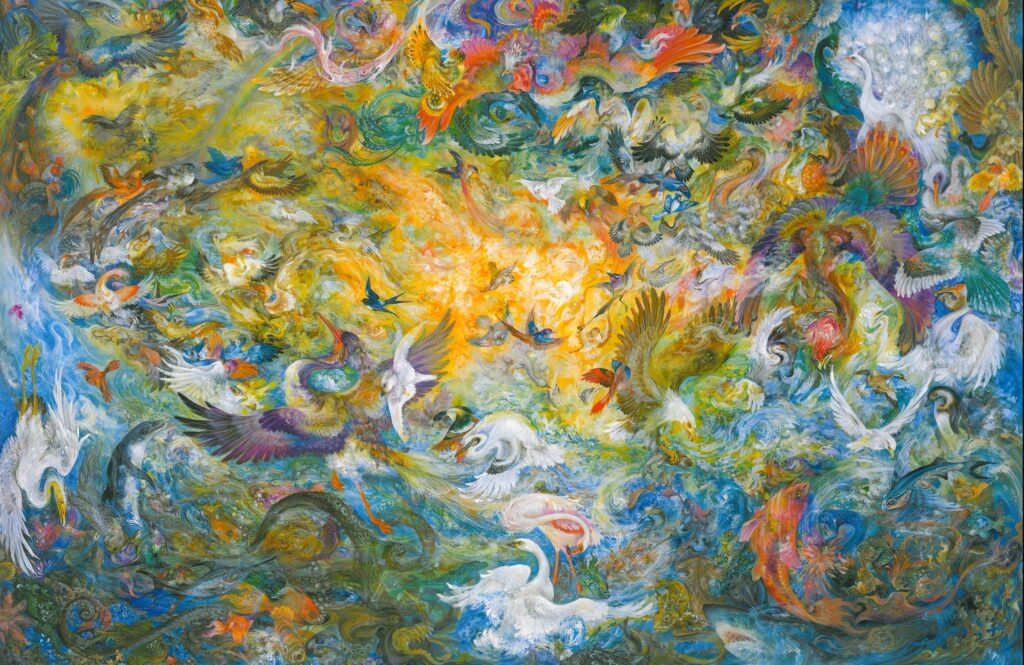
Throughout my encounters with art, I have found different reasons to connect with different paintings. Sometimes it is the composition that draws me in; sometimes it is the use of light and color, the story behind the work, or a particular detail that reveals something about the artist’s way of seeing. I have always been interested in how these individual elements contribute to the experience of an artwork.
But standing in front of The Fifth Day of Creation, I felt as though all of these things had come together.
The composition, the intricate details, the color palette, the relationships between colors, the treatment of light, and the story suggested by the image seemed inseparable. Nothing felt like an isolated visual achievement. The elements worked together to create an experience that was greater than any one of them on its own.
I found myself thinking about the depth of understanding required to make such choices: to recognize which colors could work together, how their relationships might intensify the visual impact, how to arrange forms within a composition, and how to bring these decisions together with a sense of aesthetic coherence. Behind what appeared before me was a complex relationship between observation, artistic judgment, technique, and imagination.
The experience overwhelmed me. I felt as though my heart were about to burst out of my chest. I had to leave the gallery and sit in the gardens of Sa’dabad Palace for a while, where I cried. Only after I had given myself some time to recover could I return inside and continue looking at the other works.
I struggled to explain exactly why the painting affected me so deeply. Looking back, I think part of the answer lies in the way I understand art itself.
I have never been particularly interested in evaluating an artwork through a single quality alone. A painting might have extraordinary colors, but I also want to understand its composition, its emotional dimension, the details that support its meaning, and the relationship between its visual form and the story it communicates. For me, these elements become most powerful when they work together.
I approach cinema in much the same way.
A film might be visually stunning, with striking neon colors, carefully constructed compositions, or remarkable lighting. Those qualities can make individual images memorable. But if the visual beauty exists without a compelling story or a meaningful relationship with the other elements of the film, it is unlikely to leave a lasting impression on me.
This does not mean that every film needs a conventional narrative, or that visual beauty must always serve a clearly defined plot. Cinema can communicate through atmosphere, rhythm, abstraction, and many other forms. What matters to me is that its elements belong to a larger artistic intention. I want to feel that the visual choices, the story, the performances, the sound, and the emotional experience are contributing to something coherent, rather than existing as separate achievements.
That is what I experienced when I stood before The Fifth Day of Creation. It was not one particular detail that moved me, but the relationship between all the details. The painting felt complete in a way that I found difficult to separate into individual parts.
When I was asked to choose an artist for my cinematography assignment, I knew I wanted to explore Farshchian’s work.
Studying at a university in India also gave me an opportunity to share something that was deeply meaningful to me. Among the classmates and faculty I interacted with, I found that his work was not widely known. I wanted to introduce them to his art, explain why it had affected me so strongly, and help them understand something of the visual world he had created.
My presentation therefore became more than an academic exercise. It was an opportunity to bring an artist whose work had shaped my own experience of looking at art into a new conversation.
As I researched his paintings and studied the work of other artists, I began to approach images with a different set of questions. Instead of responding only to whether a painting was beautiful or emotionally powerful, I started examining how its elements worked together. How did the composition guide my attention? How did the colors relate to one another? What role did the details play? How did the visual structure contribute to the experience of the work as a whole?
I was beginning to move from experiencing an image to investigating how it had been constructed.
And that shift brought me back to the central question of my cinematography class: if the way an artist sees the world shapes the images they create, how might understanding that way of seeing change the way I approach my own work as a filmmaker?
The Same Story, Different Visions
During my presentation, I tried to explain this idea through an imaginary situation.
Imagine asking Mahmoud Farshchian to paint a portrait of you. Before beginning, he might ask you about your life, your experiences, or a moment that left a lasting impression on you. Imagine telling him about the first time you fell in love: the moment you saw someone and felt that your heart was about to burst out of your chest, or that you had somehow become lighter, almost as if you were floating.
Now imagine that the painting grows out of the way you describe that feeling. Instead of simply depicting your face, the image might attempt to express the emotional experience itself through an imaginative, poetic visual world.
Now imagine approaching another artist with exactly the same story.
Perhaps that artist would focus on your expression, the light falling across your face, and the shadows surrounding you. Another might ask where the encounter happened, what the room looked like, what was on the table, or how the space around you contributed to the memory. The setting might become just as important as the person in the story.
These are hypothetical interpretations, not claims about what any particular artist would necessarily do. What matters is the difference between the approaches they make possible.
The event remains the same. The memory remains the same. Yet the resulting images could be entirely different because each artist might find something different worth expressing.
This thought stayed with me.
Perhaps what distinguishes one artist from another is not simply what they look at, but what they choose to see.
Every artist brings a particular way of understanding the world to their work. Some may be drawn to physical details, others to emotional states, movement, atmosphere, or the relationship between a person and their surroundings. Their attention shapes the image before the first line is drawn or the first brushstroke is made.
And this is where the idea became much more than an exercise in studying painting. It became a way of thinking about storytelling.
What This Means for Cinema
As a writer and director, I find this idea particularly important.
A story does not become visually meaningful simply because it has beautiful lighting or an interesting composition. Those elements matter when they contribute to the experience of the story. The challenge is to understand what deserves attention in a particular moment and why.
Consider the same encounter between two people: the first time one of them sees someone they will eventually fall in love with.
A filmmaker could emphasize the environment, allowing the location and the details surrounding the characters to establish the moment. Another might focus almost entirely on the character’s face, revealing the experience through a subtle change in expression. A different approach might use distance, framing, or the space between the characters to communicate hesitation, attraction, or emotional uncertainty.
None of these approaches is automatically better than the others. Their effectiveness depends on the story being told and the perspective through which the filmmaker chooses to tell it.
The writer discovers what matters in the story. The director determines how that meaning should unfold. The cinematographer translates that understanding into visual choices.
These roles overlap, but they are not interchangeable. Together, they allow a filmmaker to develop a visual language that belongs to the particular story rather than relying entirely on familiar images or established conventions.
For me, this is where the study of painting becomes especially valuable. It encourages us to ask questions before making visual decisions.
Why should the camera be here rather than somewhere else?
Why should this character occupy this part of the frame?
What does the light reveal, and what does it leave unseen?
Does the environment contribute to the story, or is it merely present because the scene needs a location?
The answers will differ from one film to another. What matters is that the choices come from an understanding of the story rather than from the assumption that a certain image will look cinematic simply because we have seen it before.
I do not believe originality requires us to avoid influence. Every artist learns from the work of others. But there is a difference between borrowing an image and understanding the principle that makes it meaningful.
A painting might teach me something about the relationship between color and emotion. A particular composition might make me reconsider the use of negative space. An artist’s treatment of movement might inspire me to think differently about the relationship between a still image and a moving one.
The task is not to reproduce those choices. It is to understand them, question them, and discover how they might serve a different story.
Bringing Paintings into Motion
For my presentation, I also experimented with using artificial intelligence to bring movement to images of Farshchian’s paintings.
The decision came from my interest in the sense of movement I perceived in his work. Although a painting is a still image, the arrangement of its forms and the direction of its lines can create a feeling of motion. I wanted to explore what might happen when those images were interpreted through movement.
Using AI allowed me to experiment with this idea and present the paintings in a different form. It also raised an interesting question for me:
when we introduce movement into a still image, are we revealing something that was already present in the composition, or are we adding a new interpretation of our own?
I find that distinction worth considering.
A moving version of a painting is not the same as the original artwork. The movement introduced by a tool may change how we experience the image, and it can introduce qualities that the artist never intended. Yet the experiment can still be valuable if we recognize it as an interpretation rather than a replacement for the original.
For me, the purpose was not to make the paintings look more cinematic. It was to explore the relationship between visual form and movement, and to consider how an image can communicate differently when its medium changes.
That experiment became another way of connecting what I was learning about painting with what I was studying in cinematography.
The World Has Not Changed, but My Way of Seeing Has
The most meaningful part of this experience was not limited to the classroom or the presentation.
As I continued looking at the works of different artists and examining their approaches, I became increasingly aware of how differently people can observe the same world. I began to think about the events and experiences we share, and how differently we interpret them depending on what we notice and what we consider important.
This awareness gradually entered my everyday life.
When I am walking outside, sitting in a room, or simply looking at an ordinary scene, I find myself paying more attention to the relationships between things. I notice how light falls across a surface, how colors interact, how an object sits within a space, or how a small change in position could alter the balance of an image.
I have started to think about framing even when there is no camera in my hands.
An ordinary scene can contain several possible images. The difference lies partly in where we stand, what we include, what we leave outside the frame, and which details we choose to notice.
I am not suggesting that studying painting has given me a completely new way of seeing everything. Rather, it has made me more conscious of the choices involved in looking. It has encouraged me to pause, observe, and question my first impression instead of assuming that what I notice immediately is all there is to see.
Perhaps this is also why studying different artists has been so valuable. Their works remind me that there is rarely only one way to interpret a subject. A different perspective can reveal a different relationship, a different emotion, or a different possibility within the same scene.
The world around us may be shared, but our attention is not identical. We select different details, assign different meanings to them, and create different relationships between what we see.
As an artist, I find that both humbling and liberating.
Before Making Images, Learn to See
Looking back, I realize that the assignment was about much more than choosing an artist and studying their paintings. It gave me an opportunity to reconsider what it means to create an image in the first place.
Cinematography involves technical knowledge, but technique alone cannot determine what makes an image meaningful. A camera can record what is in front of it, but the decisions made by the filmmaker shape how that reality is presented and experienced.
Painting helped me become more attentive to those decisions. It reminded me that composition is not simply about arranging objects beautifully, that light is not merely a way to illuminate a subject, and that visual detail is not valuable simply because it looks interesting.
Each choice should emerge from a reason, whether that reason is emotional, narrative, aesthetic, or some combination of all three.
I am still learning how to make those choices more consciously. I do not expect every image I create to be original, nor do I believe that every scene needs an unusual visual treatment. Sometimes the simplest image is the most appropriate one.
What I want is to understand why I choose it.
I want to discover what matters to me in a story, what I want the audience to notice, and how the visual language of a film can express something that words alone cannot.
Perhaps this is what I took away from that first cinematography assignment: before learning how to frame the world through a camera, I needed to become more attentive to the world itself.
Because before we decide what to put inside a frame, we must first learn what we are looking at, what we see in it, and why it matters to us.